01 / Demonstration
Handheld collection
An operator approaches and grasps a strawberry while synchronized D405 streams are recorded.
SROI V2 / open research hardware
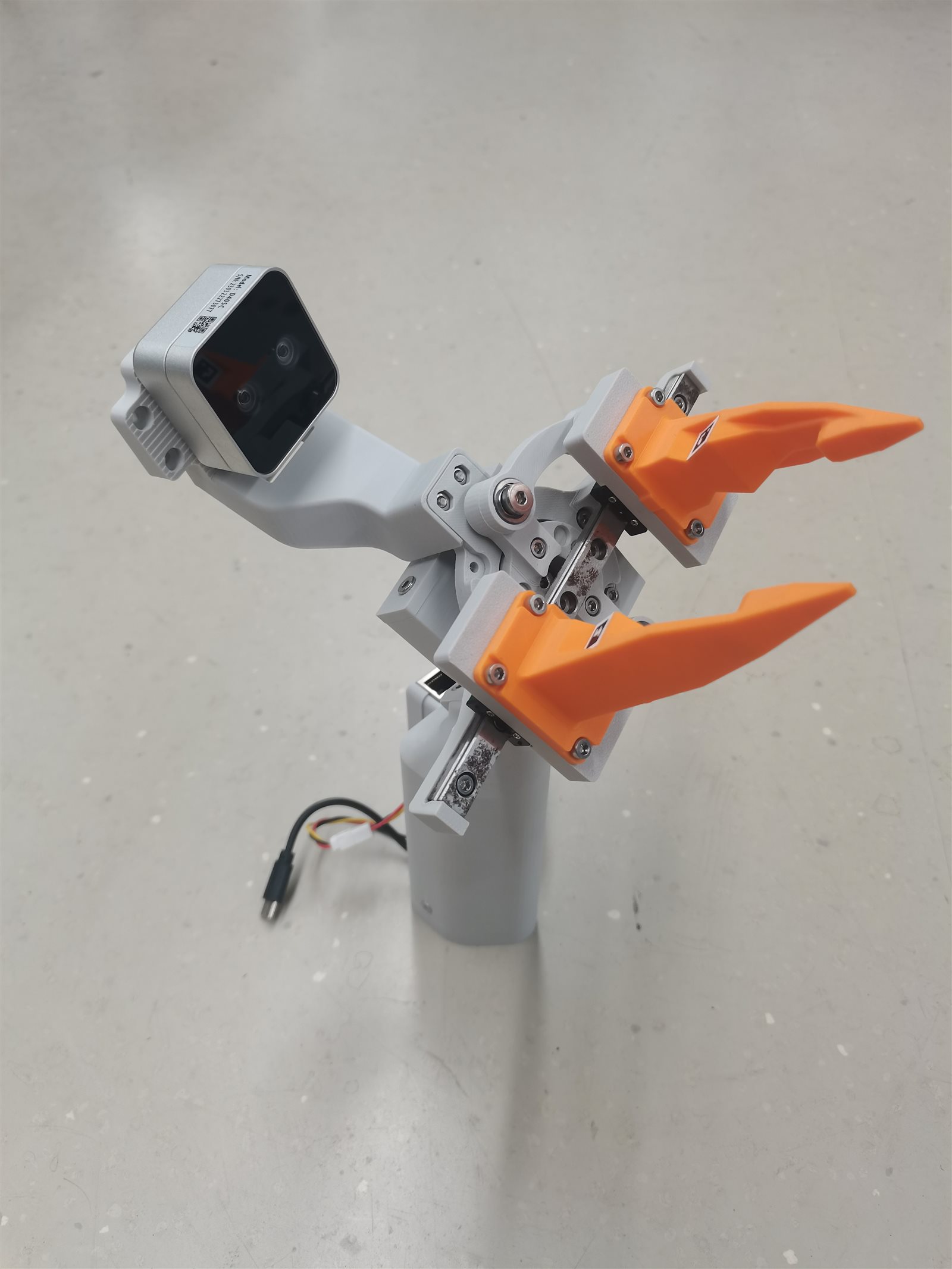
SROI V2 combines a parallel gripper, Intel RealSense D405, and portable recorder to collect first-person picking demonstrations. Related handheld and robot-mounted configurations retain the same core mechanism and camera placement.
01 / System overview
The project separates the demonstration device from the robot arm while preserving the camera-to-gripper arrangement. This provides a consistent first-person observation geometry; robot kinematics and control remain separate deployment requirements.
01 / Demonstration
An operator approaches and grasps a strawberry while synchronized D405 streams are recorded.
02 / Dataset
Stereo visual SLAM and AprilTag tracking recover camera motion and gripper opening.
03 / Deployment
The motorized configuration provides a related observation and gripping geometry for policy execution.
02 / Hardware
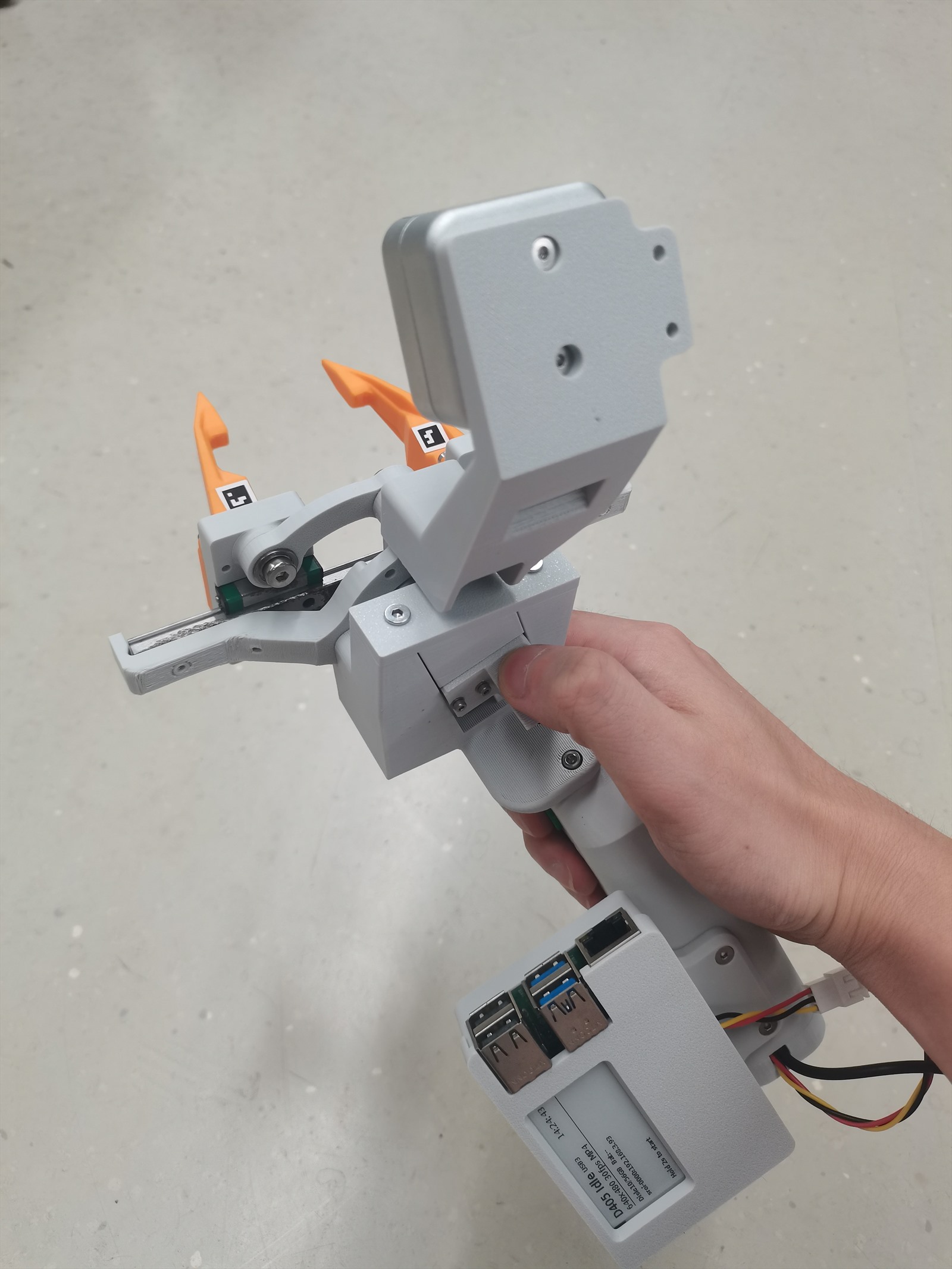
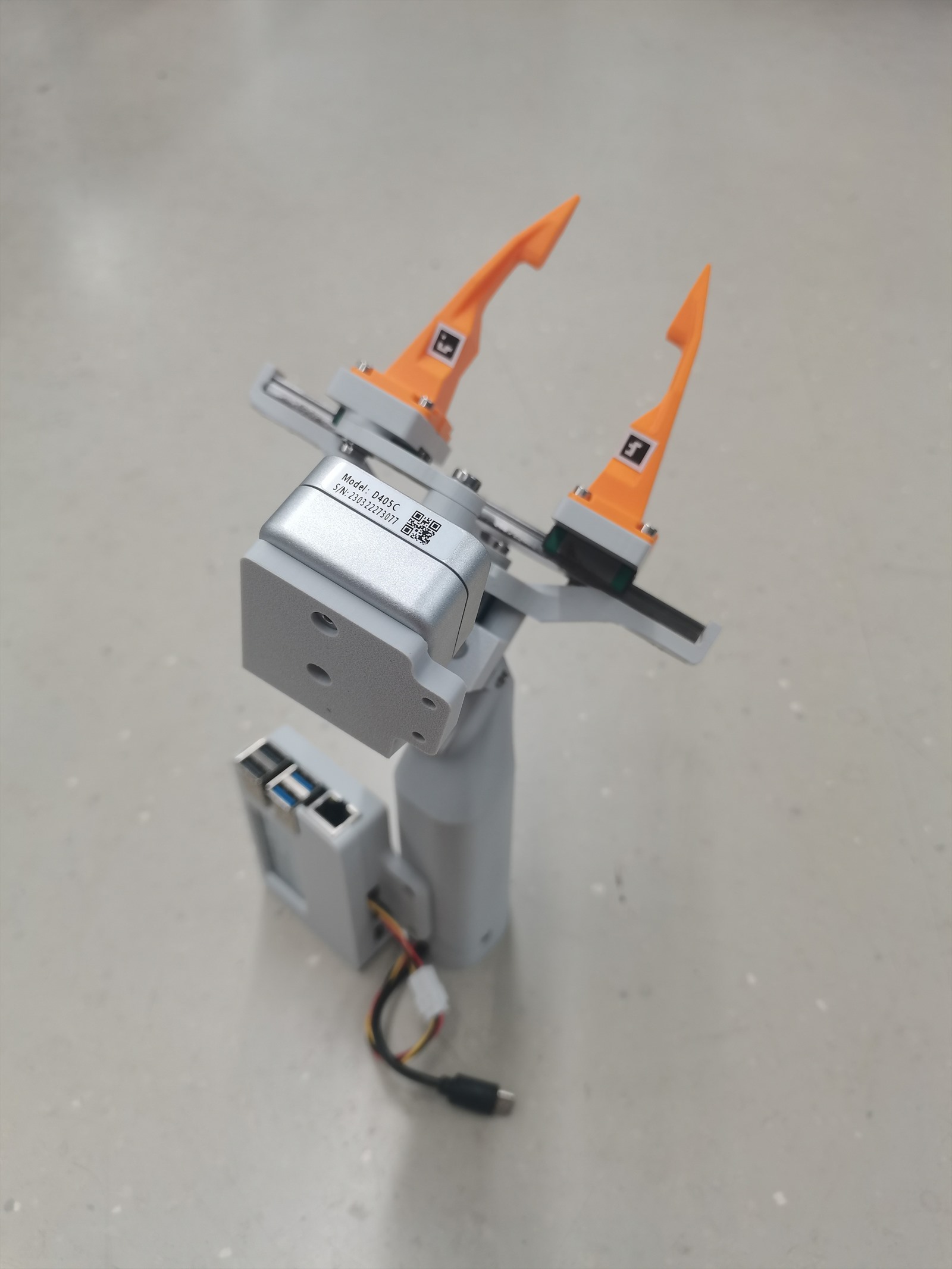
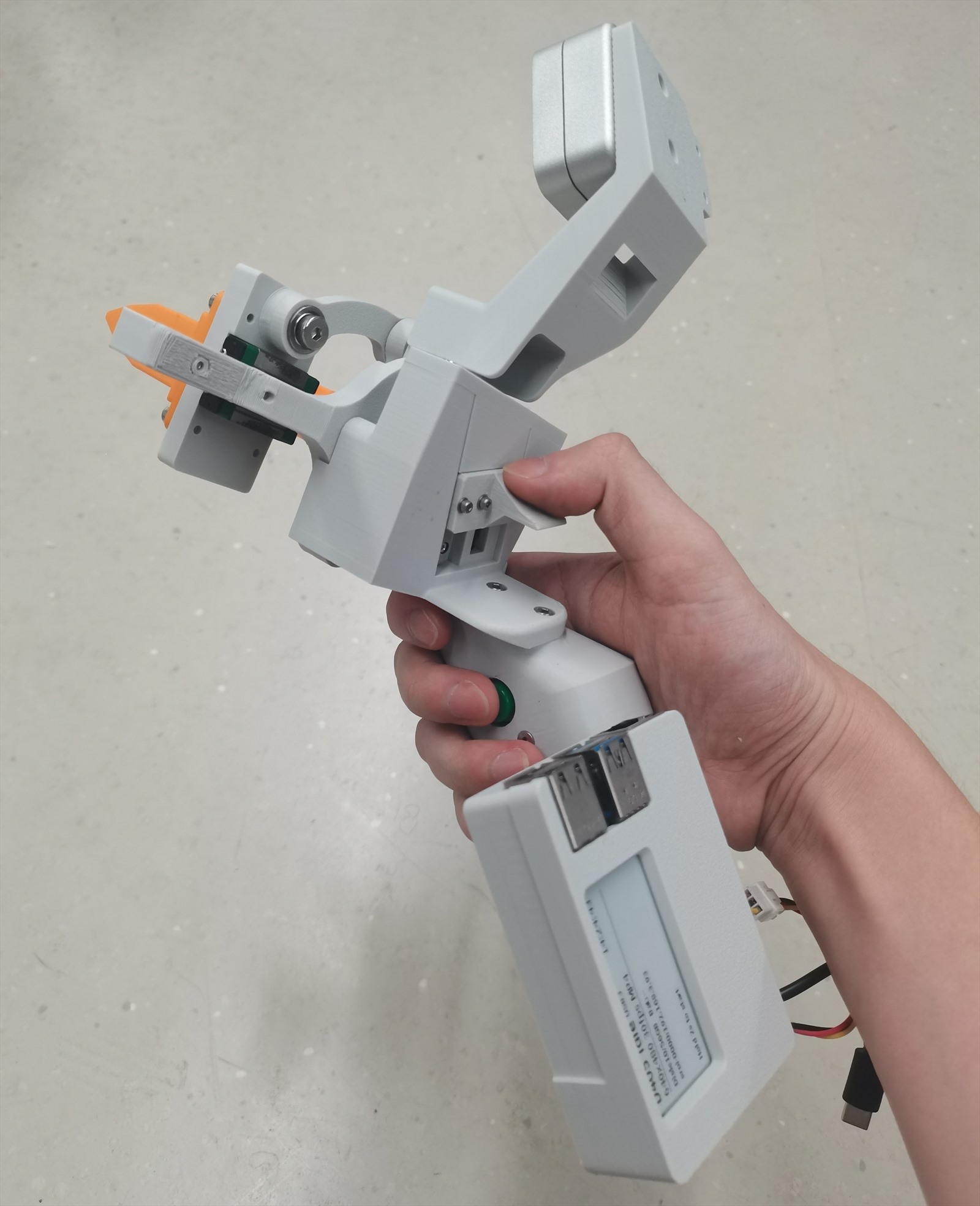
The linear guide, finger assemblies, links, rail base, and camera mount are shared. The actuation input and crank hub change according to the collection or execution role.
Robot-mounted
A crank hub connects to a joint-motor flange, including designs compatible with the DM-4310J, for installation on a robot arm.
Handheld / integrated
A slide control actuates the gripper. The Raspberry Pi and power module are integrated into the portable collection assembly.
Handheld / lightweight
Thumb and index-finger motion directly actuates the gripper while the power and recording components remain separate.
03 / Demonstration example
This example is episode 050 from the 100-episode validation recording collected on 14 July 2026. It replaces the earlier site video and is also used to illustrate every processing stage on the dataset page.
04 / Acquisition
The current recorder acquires all three D405 streams through pyrealsense2. A physical button controls the session and episode state; an e-paper display reports status and storage information.
The camera is configured and a timestamped session directory is created.
Left IR, right IR, and color frames are acquired synchronously at 640 × 480 and 30 fps.
Streams are encoded to H.264 MP4; hardware timestamps, camera intrinsics, and an ORB-SLAM configuration are saved alongside them.
The raw MP4 tree is retained. Decoding, visual SLAM, gripper extraction, QC, and LeRobot conversion run later in a separate workspace.
05 / Project components
Each repository has a defined responsibility. This separation keeps mechanical revisions, recorder deployment, offline data processing, and published datasets independently traceable.
Hardware
CAD assemblies, printable parts, bill of materials, and assembly instructions.
RepositoryAcquisition
Direct D405 capture, physical-button state machine, display integration, and deployment scripts.
RepositoryProcessing
Decoding, masked ORB-SLAM3, coordinate conversion, gripper estimation, QC, and LeRobot conversion.
RepositoryRelease
Feature schema, release lineage, validation data, processing trace, and V1 archive references.
Documentation06 / Project information
SROI V2 was developed by Zenan Sheng, Linsheng Hou, and Zhenghao Fei at Zhejiang University. For technical questions, contact Zhenghao Fei at zfei@zju.edu.cn or open an issue in the relevant repository.